
Grad school pressure is different from undergrad, because research deadlines, an advisor relationship and a tight stipend all pile up at once. The good news is that mental health resources for students at CMU and Pitt cover far more than counseling. This list of mental health resources walks you through seven steps, from your first free appointment to advisor help, money support and long-term care. If you're in crisis right now, call or text 988 or call resolve Crisis Services at 1-888-796-8226 at any hour.
Key takeaways
- CMU and Pitt grad students can get free counseling on campus.
- Both schools offer support by phone or online at any hour.
- An ombudsperson can help confidentially with advisor conflicts.
- Food pantries and emergency funds at both schools are open to grad students.
- Persad Center and other Pittsburgh options offer care after campus counseling ends.
7 Steps to Use the Mental Health Resources for Students at CMU and Pitt
Students often feel the pressure. In the Healthy Minds Study for 2024–2025, 37% of students showed signs of depression and 32% showed signs of anxiety. These steps follow the order most grad students need them in. Start with care, then fix the cause of your stress, then plan for the long term.
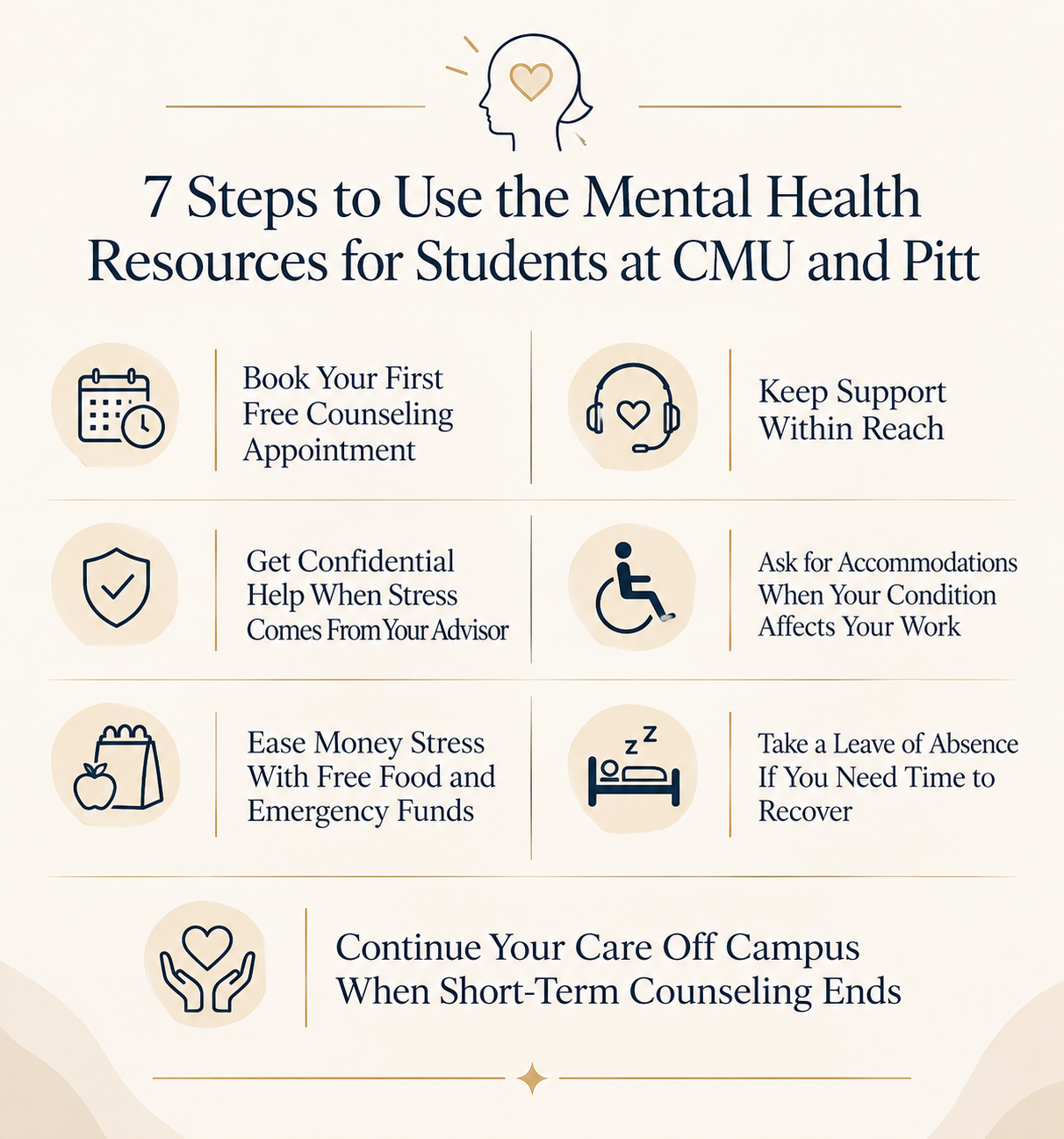
1. Book Your First Free Counseling Appointment on Campus
Your own university is the fastest place to start, and counseling is free for enrolled students at both schools. At CMU, call Counseling and Psychological Services (CaPS) at 412-268-2922 or visit 100 Tech St. At Pitt, the University Counseling Center (UCC) at 119 University Place offers drop-in hours from 9 a.m. to 4 p.m. on weekdays and a support group for grad students. In your first conversation, a counselor will learn what's going on and help you plan the next steps.
2. Keep Support Within Reach Between Sessions
Appointments run on a schedule, but stress doesn't keep office hours. CMU students can use TimelyCare, which offers TalkNow support at any hour and up to 12 scheduled sessions a year, and can reach CaPS after hours by pressing 1. Pitt's UCC line, 412-648-7930, is answered at any time, and Togetherall gives Pitt students an online peer community. For a talk that isn't a crisis, the Allegheny County Warmline at 1-866-661-9276 is another option.
3. Get Confidential Help When the Stress Comes From Your Advisor
Once you have support in place, look at where the stress is coming from, which for many grad students is the advisor relationship. CMU's Office of the Student and Faculty Ombudsperson at 4615 Forbes Ave is confidential and impartial, so you can talk through a conflict before deciding what to do. At Pitt, the Office of Graduate Studies suggests a step-by-step path that starts with a direct conversation, then your Director of Graduate Studies, then your school's Graduate Associate Dean or ombudsperson.
4. Ask for Accommodations When Your Condition Affects Your Work
Sometimes the issue isn't a person but a condition, such as anxiety or depression, that makes the workload harder to manage. Disability offices decide on reasonable accommodations for students at both schools. Contact CMU's Office of Disability Resources at 412-268-7632 or access@andrew.cmu.edu, or Pitt's Disability Resources and Services at 412-648-7890. You'll usually register with the office and share documentation from a provider.
5. Ease Money Stress With Free Food and Emergency Funds
Academic pressure often comes with money pressure, especially on a stipend, and both schools help with basic needs. The CMU Pantry at 4700 Fifth Ave is free for grad students and works by appointment. CMU's Tartan Emergency Support Fund covers short-term needs and doesn't need to be repaid, and interest-free emergency loans are also available. At Pitt, the Pitt Pantry in the O'Hara Student Center at 4024 O'Hara St welcomes walk-ins, and PittCares at 412-624-5756 can connect you with emergency help.
6. Take a Leave of Absence If You Need Time to Recover
If the stress still outweighs the support, stepping back can be the healthiest choice. At CMU, you start by talking with your advisor, then complete a leave form with the required signatures. On leave, you keep your student health insurance if you bought it before the leave, and you can still consult with CaPS, though clinical services are only for enrolled students. F-1 and J-1 students must check with the Office of International Education first. At Pitt, leave rules are set by each school, so ask your Director of Graduate Studies.
7. Continue Your Care Off Campus When Short-Term Counseling Ends
Whether you stay in school or step back, recovery often takes longer than a few sessions on campus. Most CMU students use six to eight sessions at CaPS before counselors refer them to ongoing care. Community resources for mental health can fill that gap. Persad Center at 5301 Butler St offers LGBTQ+-affirming counseling on a sliding scale and accepts most insurance. Pitt's Clinical Psychology Center offers therapy at reduced fees. Check your student insurance for in-network therapists. If you take medication, book a psychiatry appointment early so your prescriptions don't run out.
Asking for Help Is Part of Getting Through Grad School
From your first counseling appointment to long-term care, each step on this list is built for students carrying the same pressure you are. Prioritizing student mental wellness isn't a sign of falling behind. It's part of doing your best work.
Where you live can help too. A short commute to campus leaves more time for sleep, sessions and rest, and our guide to commute times from Shadyside to Pitt, CMU and UPMC shows how close Industry Pittsburgh at 5819 Centre Ave is to both campuses.